


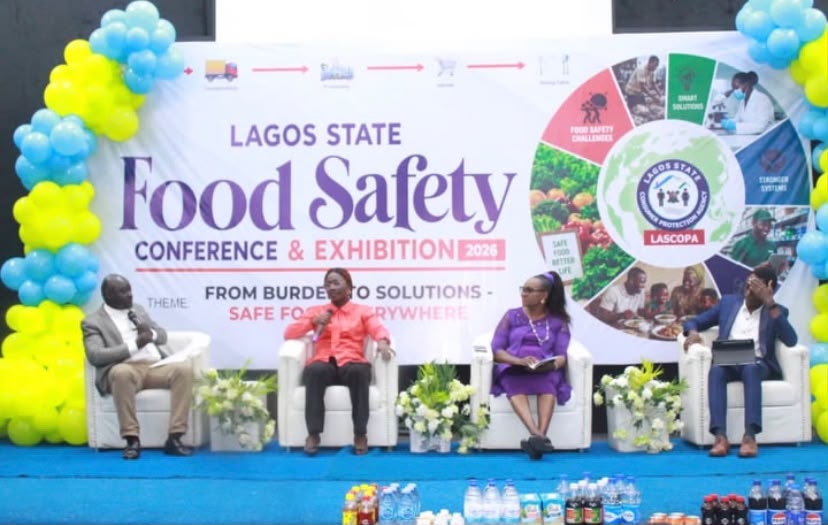
The Lagos State Consumer Protection Agency (LASCOPA) has intensified its campaign for safe food, calling for stronger enforcement of food-safety regulations, increased consumer vigilance and greater collaboration among stakeholders to tackle food fraud, adulteration and practices that threaten public health.
The call was made at the 4th Lagos State Food Safety Conference and Exhibition, held Tuesday at NECA House, Alausa, Ikeja, with the theme, “From Burden to Solutions – Safe Food Everywhere.”
The conference brought together regulators, food industry operators, professionals, consumer groups, academics, civil society organisations and other stakeholders to examine practical ways of improving food safety across the food value chain.
In his welcome address, LASCOPA General Manager/CEO, Afolabi Solebo, Esq., described food safety as more than a regulatory obligation, stressing that it is a public-health, economic and moral responsibility. He noted that Lagos’ large and rapidly growing population makes food safety a critical public-interest issue.
Solebo said unsafe food could damage public health, erode consumer confidence, hurt legitimate businesses and increase pressure on the healthcare system. He disclosed that LASCOPA had strengthened its enforcement mechanisms, expanded consumer education and public enlightenment, and deepened collaboration with relevant agencies and stakeholders.
He, however, stressed that enforcement alone could not guarantee safe food, noting that every participant in the food chain—from farmers and processors to transporters, retailers and consumers—must take responsibility. He reaffirmed LASCOPA’s commitment to ensuring that Lagos residents have access to safe, wholesome and accurately labelled food.
Delivering the keynote presentation, Global Director, Quality and Food Safety, Archer Daniels Midland (ADM), USA, Dr. Adeniyi A. Odugbemi, described food safety as a shared responsibility requiring cooperation among government, industry, academia and consumers.
Dr. Odugbemi identified food security, food sustainability and food safety as major challenges facing the global food supply chain. He advocated the modernisation and mechanisation of Nigeria’s agricultural and food-processing systems to reduce post-harvest losses and improve food availability.
He said Nigeria already has laws capable of addressing food fraud and adulteration but stressed that effective implementation and tougher sanctions were necessary to deter offenders. He also urged consumers not to compromise their health because of financial limitations, saying safe food should be accessible to everyone.
Representing the FCCPC Executive Vice Chairman/CEO, Mr. Tunji Bello, the Southwest Zonal Coordinator of the Federal Competition and Consumer Protection Commission (FCCPC), Dr. Olubunmi Otti, said no single institution could guarantee food safety without effective collaboration.
Otti described food safety as a consumer-protection, public-health, economic and trust issue, warning that unsafe food could undermine household welfare, damage legitimate businesses and erode public confidence.
She called for an ecosystem where regulators enforce, businesses comply, consumers remain vigilant, the media informs and civil society advocates. She also urged businesses across the food value chain to embrace responsible sourcing, ethical practices, regulatory compliance and consumer safety, warning that deliberate violations would attract appropriate sanctions.
Consumers, she advised, should check product labels, expiry dates and ingredients, patronise reputable vendors and report suspected violations to regulatory authorities.
On palm-oil adulteration, Food and Cosmetics Consultant, Dr. Nurah T. Oseni, warned consumers against relying on unverified methods to detect adulterated oil. Speaking on “Palm Oil Adulteration: Emerging Risks, Detection Strategies and Regulatory Control,” she explained that adulteration requires scientific testing and stronger regulatory surveillance.
Dr. Oseni specifically dismissed the popular claim that adulterated palm oil can be conclusively detected through a simple water test, noting that such a test cannot confirm adulteration. She called for stronger traceability systems, registration of palm-oil traders and products, increased market surveillance and appropriate sanctions against dealers in unapproved products.
The Association of Professional Food Service Providers in Nigeria (APFSPN), represented by its Welfare Director, Mrs. Bolanle Atanda, reaffirmed its commitment to capacity development, responsible sourcing, sound hygiene, regulatory compliance, traceability and ethical food-service operations. Its President, Mr. Tobi Fletcher, described food safety as essential to public health, consumer protection, business credibility and sustainable development of the food-service sector.
The Permanent Secretary, Lagos State Ministry of Commerce, Cooperatives, Trade and Investment, Mr. Tunde Onigbanjo, represented by the Director, Inspectorate and Monitoring Department, Mr. Asiribo Rasaq, commended LASCOPA’s efforts to promote food safety and consumer protection. Asiribo also praised Solebo’s leadership and commitment to strengthening the Agency’s impact.
The conference featured keynote and technical presentations, testimonials, a panel session, food-safety riddles, poetry and cultural displays, alongside an exhibition showcasing products, technologies and solutions for improving food safety.
Participants agreed on the need for stronger collaboration, effective enforcement, responsible business practices, consumer vigilance, traceability and sustained public education to ensure access to safe and wholesome food.
LASCOPA reiterated that Lagos residents have a right to safe food and assured the public that it would continue to strengthen its regulatory, enforcement and public enlightenment activities to protect consumer health and welfare.