
The Lagos State Ministry of Commerce, Cooperatives, Trade and Investment (MCCTI) says it is strengthening the state’s position as Nigeria’s economic powerhouse through strategic investments, partnerships, and business-friendly policies aimed at making Lagos Africa’s leading investment destination.
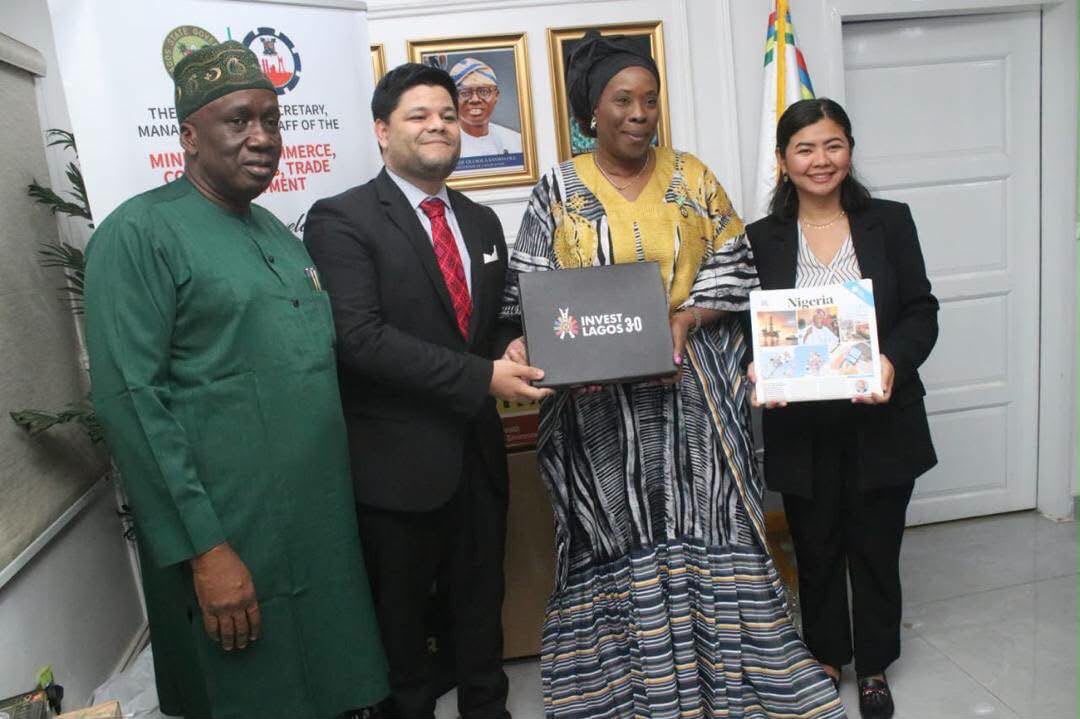
Speaking during an interview with The Report Company, in collaboration with USA Today, Commissioner for Commerce, Cooperatives, Trade and Investment, Mrs. Folashade Ambrose-Medebem, said 2024 marked a year of transformation for the ministry, while 2025 is focused on partnerships, institutionalisation, and accountability.
She disclosed that Lagos attracted over ₦50 billion in Foreign and Domestic Direct Investments within her first year in office. This includes ₦38 billion invested by Twinings Ovaltine Nigeria Limited, which has committed to full-scale manufacturing in Lagos, creating 112 direct jobs, over 200 distributor positions, and generating more than $8 million in exports across West Africa.
The commissioner highlighted the Lekki Economic Zone as one of the ministry’s biggest achievements. She noted that the $1.5 billion Lekki Deep Sea Port, located within the Lagos Free Zone, has transformed Nigeria’s maritime sector and positioned Lagos as an emerging logistics hub in West Africa. She also referenced a February 2025 Memorandum of Understanding between Lekki Worldwide Investment Limited and the Lagos Free Zone Development Company, alongside the $50 million equity investment by the International Finance Corporation (IFC) to accelerate the zone’s development.
Ambrose-Medebem also unveiled Operation Quadrant Ignite (OQI), a strategic industrial policy designed to position the Lekki Economic Zone as Africa’s premier destination for manufacturing, trade, and investment, describing it as a long-term commitment to sustainable industrial growth and economic expansion.
According to her, Lagos currently ranks first among Nigeria’s 36 states in the Presidential Enabling Business Environment Council (PEBEC) Ease of Doing Business rankings, with a score of 85.6%, driven by the digitalisation and automation of business registration services.
On SME development, she revealed that Lagos has over 3,000 active cooperative societies with an annual financial turnover exceeding ₦70 billion. Through partnerships with the Bank of Industry and Sterling Bank, the ministry launched the Lagos State Access to Finance for SMEs through Cooperatives (LASMECO) programme, offering low-interest loans of up to ₦10 million at 9% interest to businesses in sectors including healthcare, agriculture, manufacturing, creative industries, and the circular economy.
She added that the ministry is collaborating with the Lagos Chamber of Commerce and Industry (LCCI) on power, energy, and finance initiatives, while the Lagos State Employment Trust Fund (LSETF) has disbursed over ₦8.4 billion to 12,710 MSMEs.
The commissioner identified health, manufacturing, energy, food, and technology as priority sectors for investment and stressed the importance of the creative industry. She said projects such as the Lagos Film City in Epe and the Fashion Hub are designed to position Lagos as Africa’s creative capital by promoting film, music, gaming, fashion, tourism, and African culture.
She reiterated the ministry’s commitment to institutionalising its initiatives, strengthening collaboration with the Federal Government and private sector stakeholders, and using platforms like Invest Lagos to showcase the state’s investment opportunities.
According to Ambrose-Medebem, Lagos remains the gateway to doing business in Africa, insisting that any investor seeking to operate at scale on the continent cannot ignore the state.
The interview concluded with an exchange of souvenirs, including Lagos’ iconic Eyo effigy and a branded Bàtá drum, symbolising the state’s commitment to strengthening international partnerships and promoting its cultural identity.